
Seven details are worth recording for every policy: the policy number and insurer, the type, the premium and how often it is paid, the renewal due date, the best way to reach the client, who is covered, and your last contact with the next step. With these, a renewal never needs detective work.
The list is short on purpose. Record more and you will stop keeping it up to date. Record less and renewals will surprise you.
Want these seven fields in a form that takes under a minute? Advisend asks for them when you add a policy. Start free. No card needed. Start free in minutes.
The seven things
1. Policy number and insurer
This is how you find the policy in seconds and how a client confirms they mean the same one. Record the insurer exactly as it appears on the document, and add the plan name if there is one.
2. Policy type
Health, life, term, motor, home or something else. The type tells you what to say. A motor renewal sounds different from a term plan, and different types may fall due on different cycles.
3. Premium amount and how often it is paid
Record the amount you will quote in your reminder, and whether it is paid yearly, half-yearly, monthly or once. A one-time premium never renews, so it should not clutter your renewal list.
4. Renewal due date
This is the single most important field. Use the date on the policy document, not “a year from today”. A date that is off by a few days is how renewals are missed.
5. The best way to reach the client
Record the mobile number, the email and, if you know it, the time they usually answer. If a client does not read email, you want to know that before the due date, not after.
6. Who is covered
Note the family members or vehicles covered. This helps in two ways: you can spot gaps when the family changes, and you ask smarter questions at the 60-day check.
7. Last contact and next step
One line is enough: “Called 3 Oct, will pay by 10 Oct, call on 11 Oct.” This is what stops you from asking the same question twice and turns a list into a plan.
What the seven look like for one policy
Here is a single policy recorded properly. The details are made up.
| Field | Entry |
|---|---|
| 1. Policy number and insurer | HLT-4821907, Star Health |
| 2. Policy type | Health |
| 3. Premium and how often | {Amount}, paid yearly |
| 4. Renewal due date | 15 Oct 2026, from the policy document |
| 5. How to reach the client | 98765 00203, WhatsApp is best, after 6 pm |
| 6. Who is covered | Client, spouse and one child |
| 7. Last contact and next step | Called 3 Oct, will pay by 10 Oct, call on 11 Oct |
It takes about a minute to enter and saves much more than that each year.
Five mistakes to avoid when recording policies
- Entering a rounded date. “Mid-October” is not a due date. Use the exact date on the document.
- Skipping the premium. Without the amount, your 30-day message has nothing to say.
- Writing a note nobody can read later. “Spoke, ok” tells you nothing a month on. “Said she will pay by 10 Oct” does.
- Mixing a one-time premium into the renewal list. It never renews. Keep it in the client record only.
- Recording nothing about the client’s preferred channel. If a client answers only on WhatsApp, you want that written down before the due date.
If you advise on SIPs and mutual funds
The same idea works for investments, with different fields. For a distributor, the seven things become:
- Scheme name and folio number
- Type (equity, debt, hybrid and so on)
- Instalment amount and frequency
- Instalment date and mandate expiry date
- How and when to reach the investor
- Who the investor is investing for, such as a goal or a family member
- Last contact and next step
The dates to watch are the instalment date and the mandate expiry. A failed or stopped instalment deserves a message the same day. The SIP follow-up checklist has a weekly routine, message templates and a tracker for exactly this. Rules differ by fund house and bank, so check them before telling an investor what happens next.
Keep it current with a two-minute habit
A record is only useful if it is true today. The habit that keeps it true is simple: update the policy right after the call, while you still remember what was said. Two minutes now saves a long and unreliable catch-up on Friday evening.
A good update has three parts: what happened, what was promised, and what you will do next with a date. “Called, she will pay by 10 Oct, I will call on 11 Oct” is a complete update.
Keep client records safe
You are holding names, phone numbers and policy details, so treat the list with care. Keep one master copy rather than many, avoid sending the whole file over chat apps, and keep a backup. If you use a spreadsheet, protect the file with a password. If you use an app, choose one that is clear about how it stores your data.
What the seven look like in a tool
A good tool asks for these in a form that takes under a minute. Advisend’s Add policy page asks for the customer, policy number, insurer, type, how often the premium is paid, the premium and the next renewal due date.
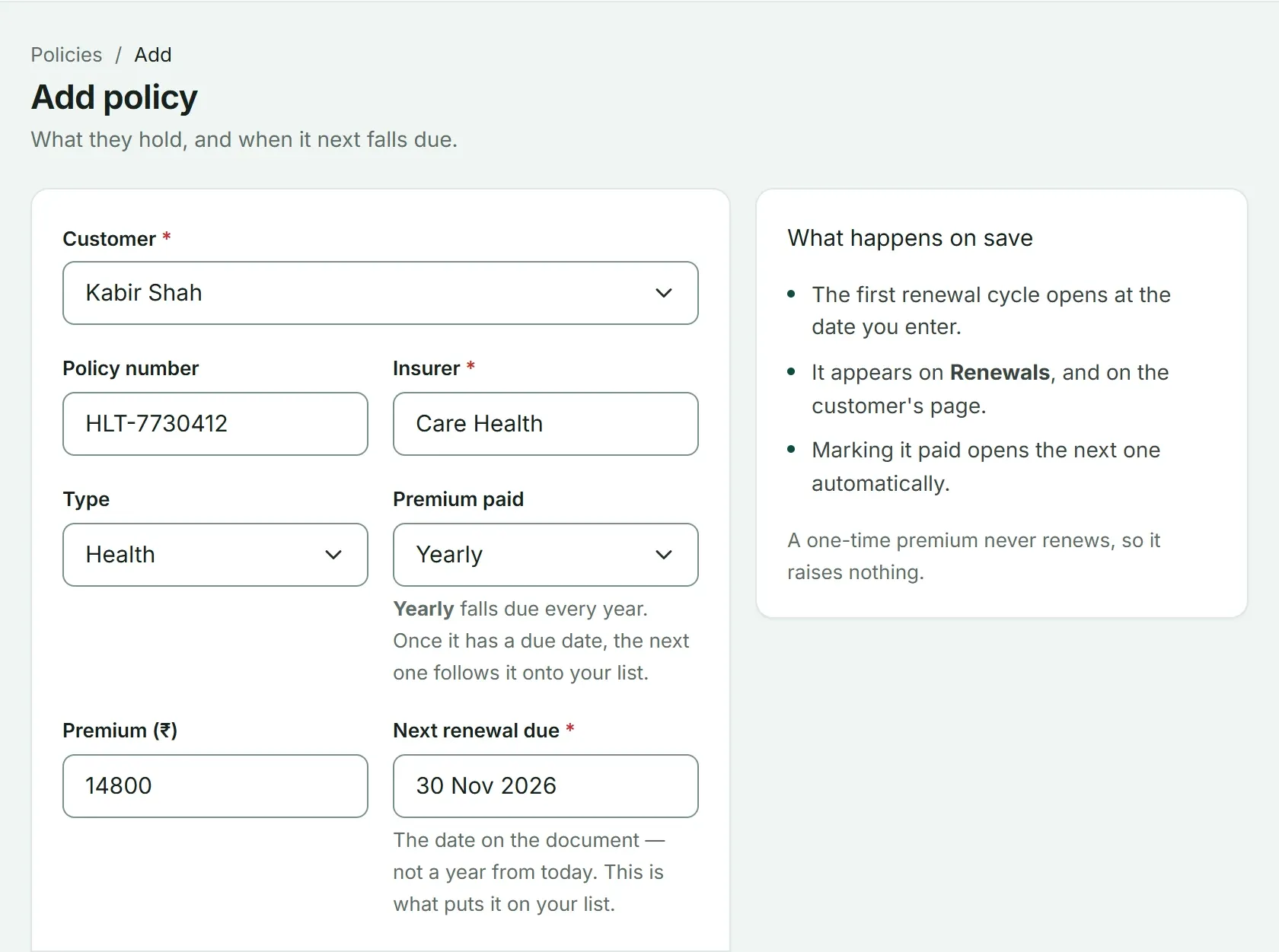
The Add policy form in Advisend. The panel on the right explains what happens on save: the renewal appears on the Renewals page, and marking it paid opens the next one.
Contact details and the follow-up record live on the customer page, next to the policy list. Who is covered is worth adding to your notes. To see how a client’s policies, contact details and history come together, see how Advisend handles client relationships.
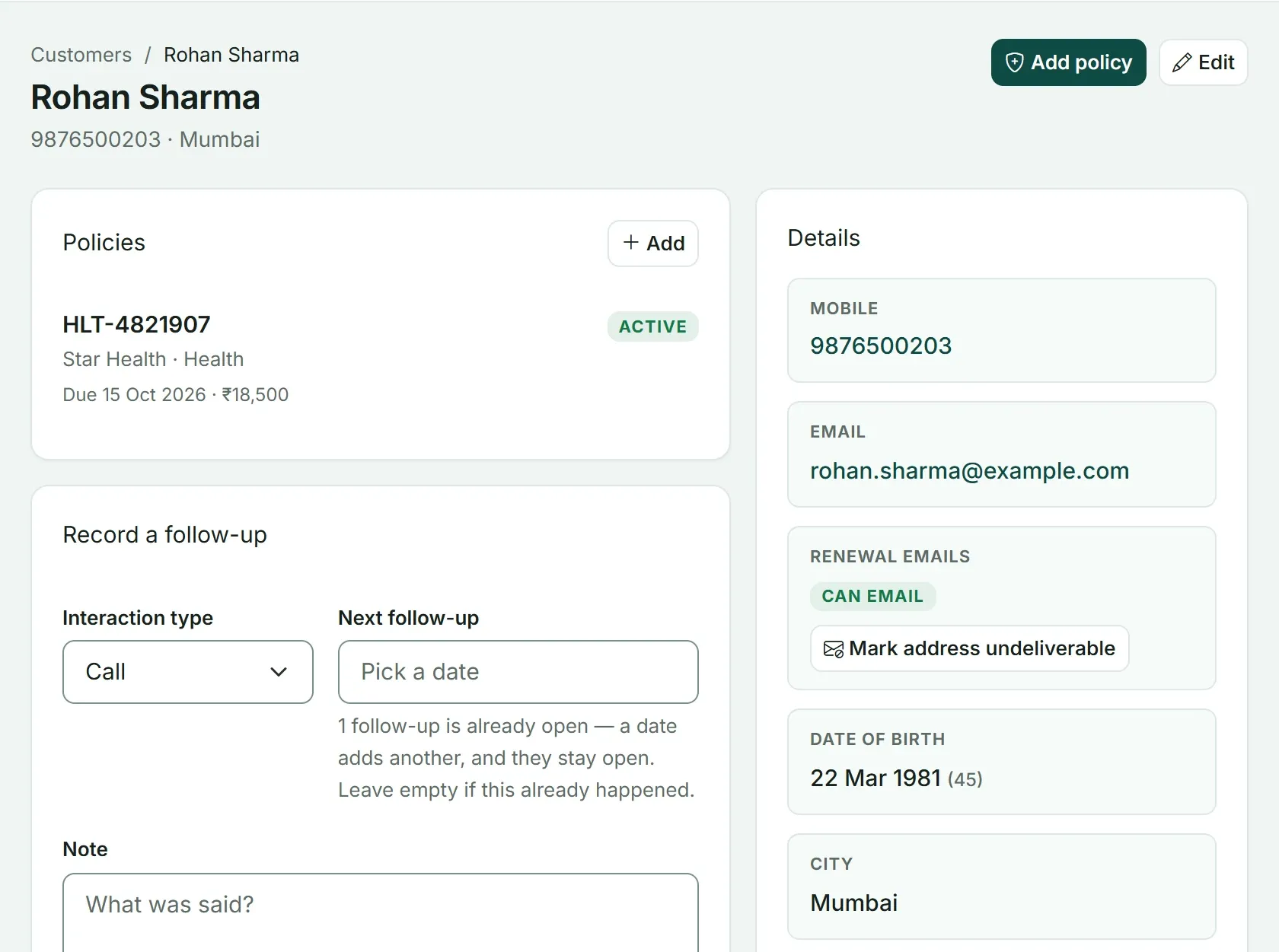
A customer page: policies at the top, contact details on the right, and a form to record the next follow-up.
A quick check for your own list
Open your current tracker and pick five policies at random. For each one, can you answer these without looking elsewhere?
- When is it due, and for how much?
- Who do I call, and on which number?
- What did I last say to this client?
- What am I doing next, and when?
If any answer sends you to another notebook or chat, add that field to your list. Then use the 90-60-30-7 timeline to decide when to contact each client, and the renewal tracker template if you want the columns ready made. The routine that keeps the list current is in How to track insurance renewals without missing a single one, and the whole system is in Insurance renewal management for agents.
To look after the client behind the policy, read Client relationship management for agents.
Ready to put your first policies in? Start free. No card needed. Start free in minutes.
Questions agents ask
What is the minimum I must record for every policy?
The client, the policy number, the insurer, the premium and the renewal due date. With those five you can run a basic renewal list. The other two items, who is covered and your last contact, make it work much better.
Should I record one-time premium policies?
Record them for your client history, but they do not renew, so they should not appear in your renewal list. In Advisend, a one-time premium raises no renewal.
How often should I update the records?
Update a policy every time something changes: after each contact, after a payment, and when a client tells you about a change. A two-minute update right after a call is easier than a long catch-up later.
Where should I record this information?
Anywhere you can search it by name, policy number and due date. A spreadsheet works. So does an app that holds policies against each client.
One list of what is due and what is late, with reminders sent on the days you choose.
Advisend keeps your renewals in one place and reminds you by email and WhatsApp, so you can spend your day with clients.
Keep reading
How to Track Insurance Renewals Without Missing a Single One
The four ways agents track renewals, where each one breaks, and a simple daily and weekly routine that keeps every due date in front of you.
Updated 27 Oct 2026TemplateInsurance Renewal Tracker in Excel and Google Sheets: Download the Template
A ready-made Excel renewal tracker that counts the days left, colours every policy by urgency and shows who to call today. Works in Excel and Google Sheets.
Updated 27 Oct 2026GuideThe 90-60-30-7 Renewal Reminder Timeline (With Exact Actions)
What to do 90, 60, 30 and 7 days before a renewal, and on the due date: the exact message, the exact action, and why each step is there.
Updated 27 Oct 2026