
Client relationship management is the routine that keeps your clients with you for years. It has four parts: record what matters about each client, stay in touch at the right moments, look after them between renewals, and ask for referrals gently. An agent who does these four things is the one clients think of first, and rarely has to win the same client twice.
This guide walks through the whole system. Each section links to a shorter post with a template you can use today. Read it from top to bottom, or jump to the part that is hurting you most.
If you want the system running while you read, Advisend keeps every client, policy and conversation in one place. Start free. No card needed. Start free in minutes.
Why clients drift away
Clients rarely leave in anger. They drift.
A client buys a policy from you, pays it once or twice and hears from you only at renewal. Years pass. Another agent calls on their birthday, remembers their daughter’s name and asks how the family is. When the next need comes up, the client does not think of you. It is not that you did anything wrong. It is that you were not there in between.
The cost shows up in three places:
- The client. Someone who trusted you gets advice from a person who has not earned that trust.
- Your book. Policies are moved, renewals are lost and the clients you worked hardest to win quietly become someone else’s.
- Your future leads. Satisfied clients are your best source of referrals. A client who has lost touch rarely recommends you.
You do not need a statistic to see it. Any agent who has heard “I did not know you also do that” knows the feeling. The system below is built so that staying in touch does not depend on a good week.
Where agents keep client details today, and where each one breaks
Almost every agent starts with one of these.
| Method | What works | Where it breaks |
|---|---|---|
| Phone contacts | Always with you | No dates, no family, no history |
| Paper diary | Quick to write | Hard to search. One lost diary loses everything |
| Policy files and insurer portals | Official records | Organised by policy, not by person. Nothing reminds you |
| Spreadsheet | Searchable and shareable | It does not remind you. One row cannot hold a relationship |
| Client app | Holds the person, the policies and the history together | Needs a short setup, and you enter each client once |
Every method fails the same way: the client is spread across too many places, and nothing tells you who has not heard from you. For a ready-made sheet, use the client database template.
The system: record, stay in touch, look after, grow
Four steps, in order.
- Record. Keep one card for each client with what matters, and nothing more.
- Stay in touch. Contact each client at the right moments, not only at renewal.
- Look after. Treat reviews, new needs and long-term loyalty as part of the job.
- Grow. Ask for referrals and offer new cover in a way clients welcome.
Then, once a month, check who has not heard from you.
Step 1: Record what matters about each client
A client card is the one page you open before you call. It should tell you who the client is, what they hold, and what you last said, without a search through chats and files.
Keep it short on purpose. Record more and you will stop keeping it up to date. Record less and you will not know your clients.
| What to record | Why it helps |
|---|---|
| Name, mobile, email and city | The basics, in one place |
| Date of birth | Age shapes what a client can buy and what it costs, and it gives you a date to remember |
| Other important dates | A wedding anniversary or a child’s birthday, if the client shares it |
| Family members | Helps you ask better questions at a review |
| Policies and investments held | A quick view of what each client has |
| Best way and time to reach them | Contact them the way they answer |
| Whether they are happy to be emailed | Respect it, and record it |
| Last contact and next step | So nobody goes quiet by accident |
| A note on what they care about | Their worry, their goal, their way of speaking |
For the policy side, see 7 things to record on every policy.
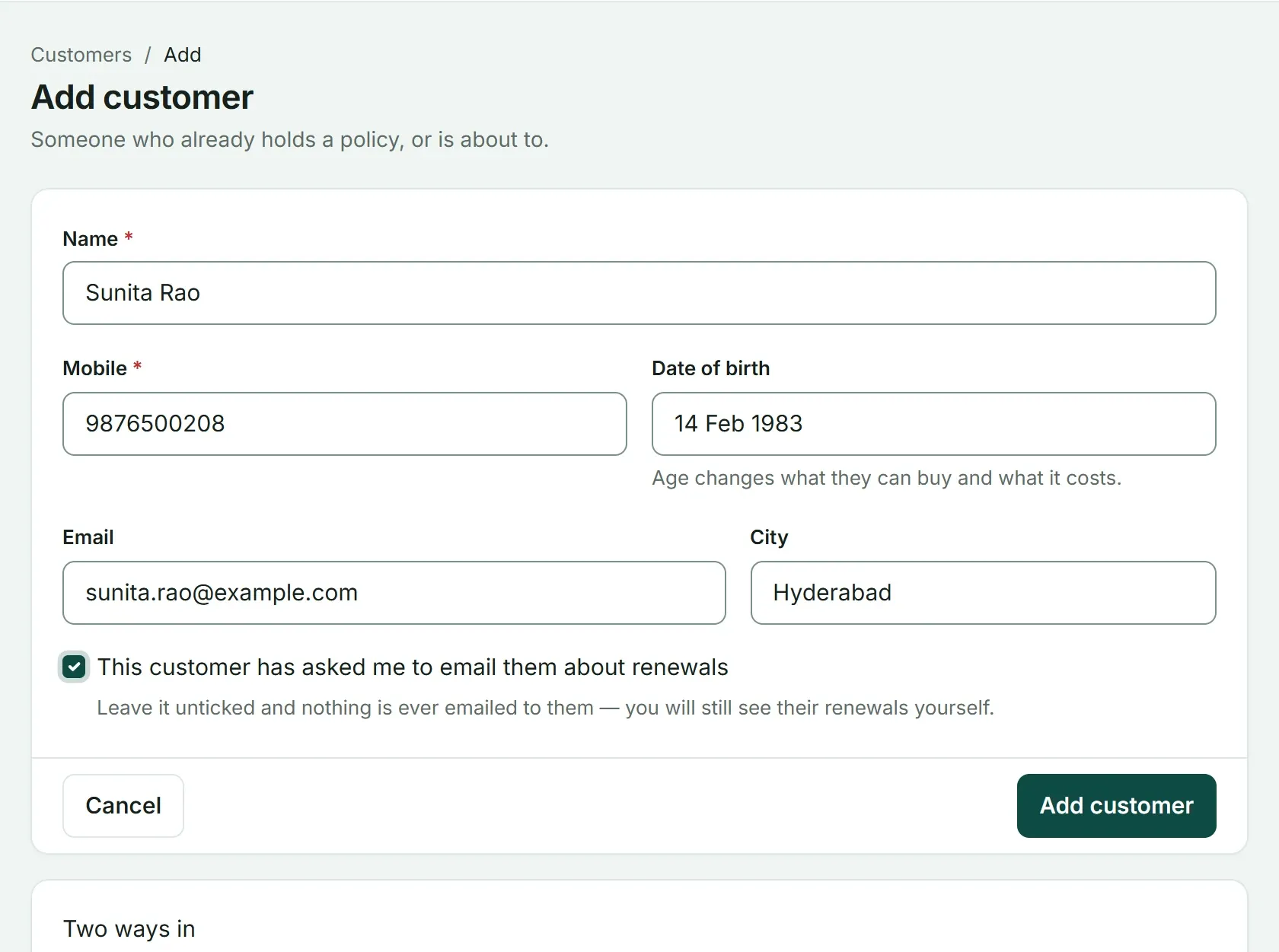
Advisend’s Add customer form asks for name, mobile, date of birth, email and city, with a box to record whether the customer has asked to be emailed about renewals.
Keep client details safe
You are holding names, phone numbers, dates of birth and family details. Treat the list with care. Keep one master copy, protect the file or the app with a password, keep a backup, and avoid sending the whole list over chat apps. If you use an app, choose one that is clear about how it stores your data.
Step 2: Stay in touch at the right moments
Most agents contact a client when a premium is due. The agent who is remembered also contacts them when nothing is due.
A simple year has four kinds of contact:
- Renewals. A calm reminder, a payment link and a thank-you. The routine is in Insurance renewal management for agents.
- Important dates. A birthday or an anniversary message.
- A review. Once a year, a conversation about what has changed for the client or the family.
- A short check-in. A message with no ask, such as after a festival or a news item that affects them.
Remember important dates
A birthday message takes a minute. Remembering to send one to every client is the hard part.
Save each client’s birthday and other important dates once, and let a reminder bring them to you on the day. A short, personal message is enough: “Happy birthday, Priya. Wishing you a lovely year ahead.”
One rule matters. A birthday or an anniversary is not a sales opening. It tells a client you know them as a person, and that is the whole point. Clients who feel known tend to stay. Send the message and leave the selling for another day.
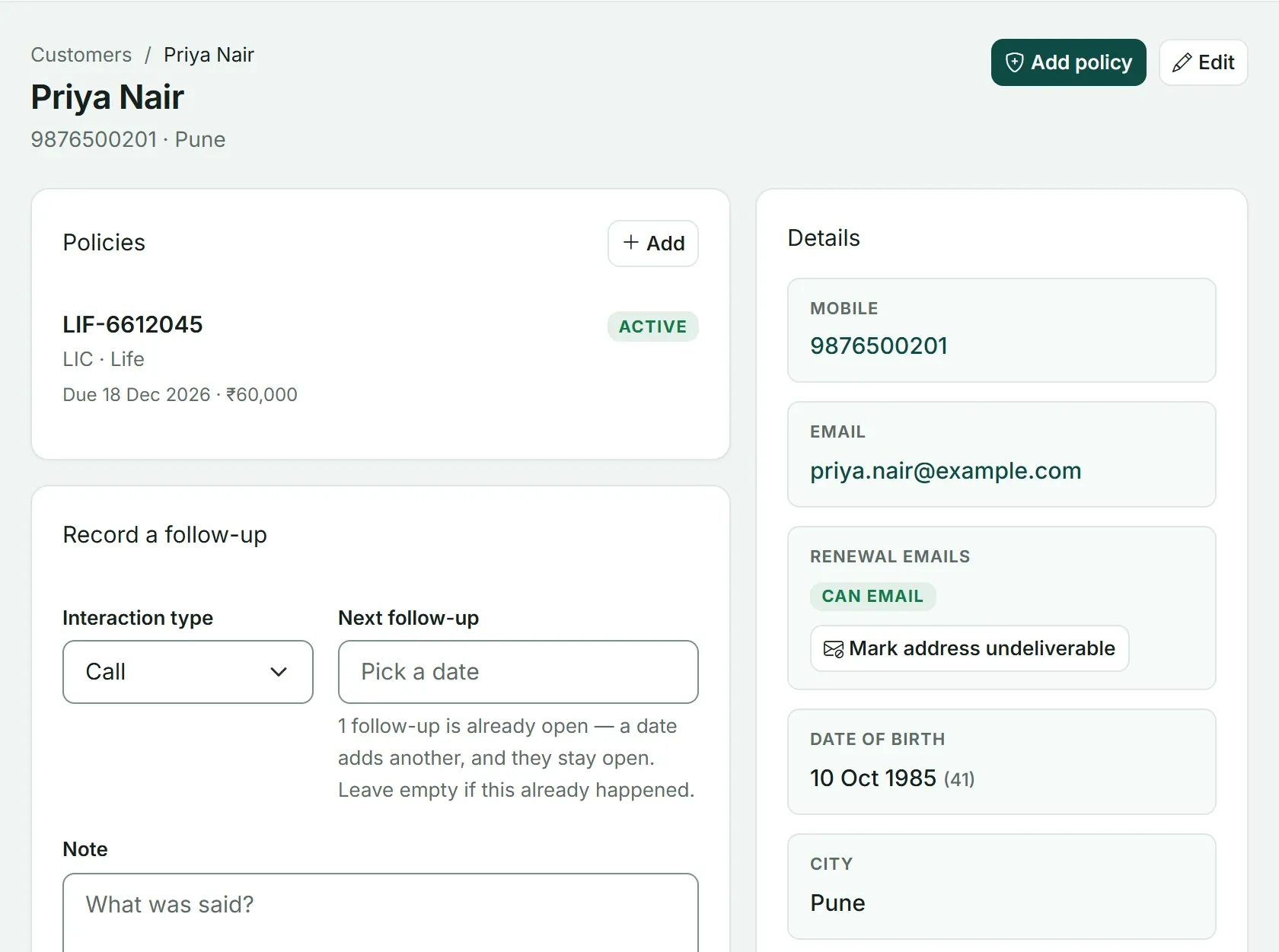
A customer page in Advisend: policies on the left, and on the right the contact details, whether the customer can be emailed, and the date of birth.
How often is often enough?
There is no perfect number. A simple starting point is to contact every client at least a few times a year, each time with a reason. A client with several policies, a large account or a close relationship deserves more. A client who prefers to be left alone deserves less, and you should write that down.
Contact them the way they answer
Some clients read WhatsApp within minutes and never open email. Some prefer a call. Record the best channel on their card, and use it. A message sent the wrong way feels like noise, and the right way feels like care.
Step 3: Look after them between renewals
Looking after a client is mostly small, regular things done well.
Hold an annual review
Once a year, set aside half an hour with each important client, in person or by phone. Ask what has changed: a new family member, a new city, a new vehicle, a change in income. Check that the cover still fits. Write down what you learn.
A review is a service, not a pitch. Many reviews end with no change, and that is fine. The client leaves knowing that someone is paying attention.
Treat a new need as a follow-up
When a client mentions a new need, such as a car cover years after a health plan, or a plan for a child, that is not a new lead. It is a follow-up on a client you already know. Set a date, call and carry on the conversation.
In Advisend, you set the follow-up on the client’s page. In a sheet, add a next contact date. For the follow-up rhythm itself, see Lead follow-up for insurance agents.
Cross-sell gently
Clients buy more from an agent they trust. The gentle way is to listen first, notice a gap in their cover, and mention it once, with a reason. Do not push. A client who feels pressed will remember it, and a client who feels helped will come back.
Appreciate long-term clients
A client who has been with you for years has earned more than a renewal reminder. A short thank-you on the anniversary of their first policy, a call after a claim goes well, a note at a festival: small things, done sincerely, are rarely forgotten. None needs to cost anything.
Step 4: Grow through referrals
Satisfied clients are the best source of new leads, and most never get asked.
Ask when the moment is right: after a claim has gone smoothly, after a review that helped, or after a client thanks you. Keep it simple and low-pressure.
Hello {Name}, I am glad I could help with {thing}. If you know anyone who would like the same help, please feel free to pass on my number. No pressure at all.
Thank the person who refers someone, whatever happens next. When the referral arrives, add them as a lead, record who sent them and start the follow-up. The system for that is in Lead follow-up for insurance agents.
Review every month
Once a month, spend 30 minutes looking at your clients, not your sales. You do not need a dashboard.
| Question | Why it matters |
|---|---|
| Which clients have I not contacted in the last 90 days? | A quiet client is easier to lose |
| Whose important dates are coming up this month? | So no message is missed |
| Which renewals are coming up, and have I spoken to those clients recently? | A renewal should never be the only contact |
| Which clients had a new need that I have not followed up? | Do not let a new need go cold |
| Who could I ask for a referral? | Your next leads are among your best clients |
Excel or an app?
A sheet is a good place to begin. It gives you search and colour, and you own the file. Its weak points are the ones that hurt on a busy day: it never reminds you, one row cannot hold a year of conversations, and policies live in a separate sheet that drifts out of date.
An app earns its place when you want the dates to come to you and every client to have one page with their policies, details and history. A simple rule: if you have forgotten an important date, or you cannot see what you last said to a client without searching, try an app. The honest side-by-side, written for renewals but true for clients too, is in Excel or a renewal reminder app?.
How Advisend handles client relationships
Advisend is built around exactly this system. This is what it does today.
- One page per client. Policies, contact details, date of birth, city and every follow-up sit together.
- Important dates, saved once. Add birthdays and anniversaries when you save a client, and get a reminder when it is time to reach out.
- A Today list. Everyone who needs you today, including a birthday wish, in one place.
- Follow-ups on the client’s page. Record what was said and set the next date.
- Email consent. A box that records whether the customer has asked to be emailed about renewals.
- Search. Find a client by name, mobile or email.
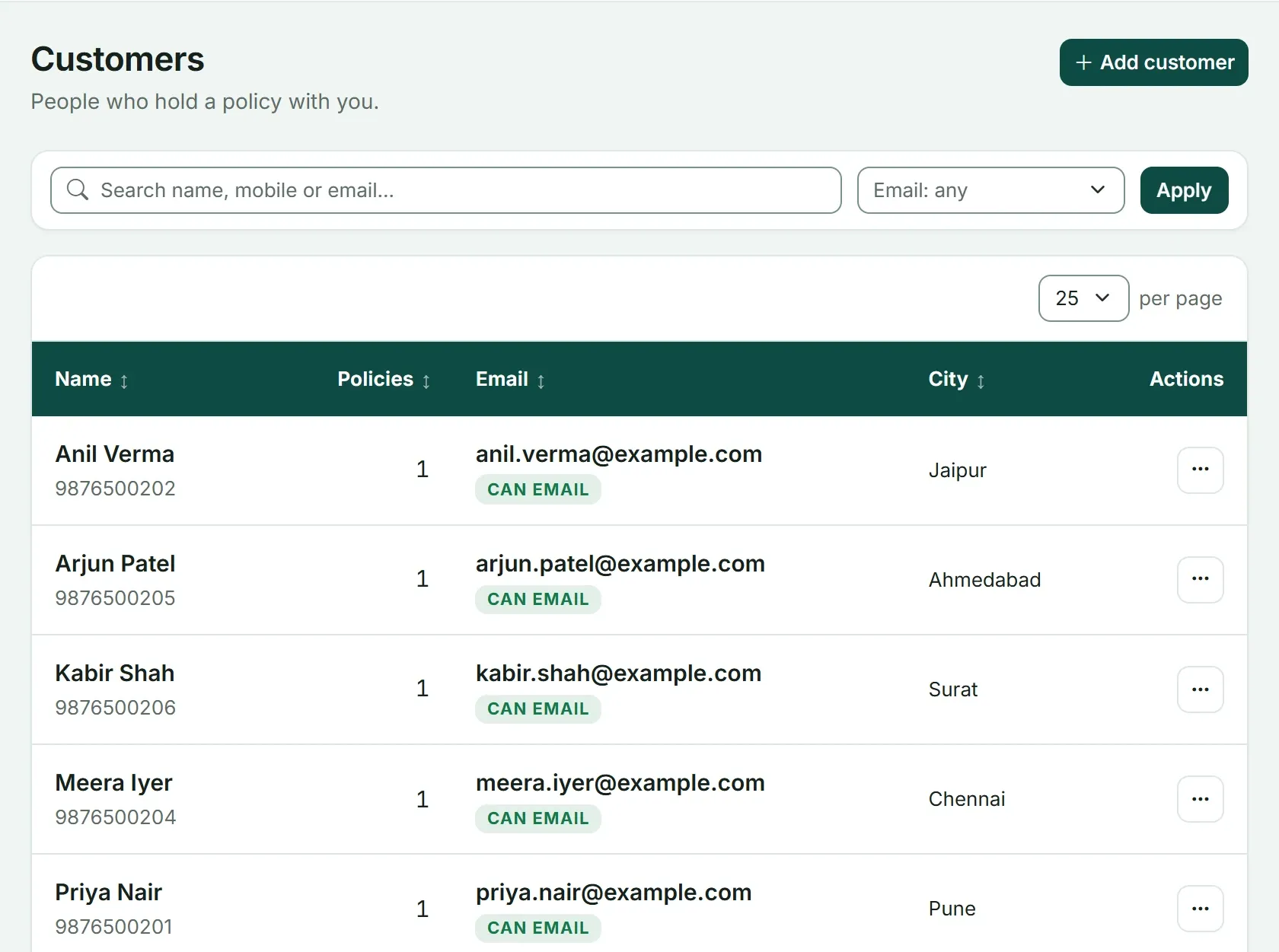
The Customers list: each client with their mobile, number of policies, email and city.
Advisend reminds you when it is time, and you send the message yourself, in your own voice. We are also working on letting you send messages from your own WhatsApp number.
See how Advisend handles client relationships, or start free and add your most important clients first. No card needed. Start free in minutes.
Six mistakes that lose clients
- Contacting clients only at renewal. If the only message is about money, that is all the relationship is.
- Forgetting important dates. The agent who remembers is the agent who is remembered.
- Turning every message into a sale. Clients notice, and they stop answering.
- Keeping details in too many places. The note you need is always in the other place.
- Not recording the next step. A promise to call that is not written down is a promise that will be broken.
- Sending the whole client list around. Keep it private, and treat it as personal information.
A 30-day plan to put the system in place
Week 1: gather. Put your most important 25 clients into one list or app. Add dates of birth and any important dates you know. Do not worry about perfect data.
Week 2: choose the channel. Record the best way to reach each client and whether they are happy to be emailed.
Week 3: reach out. Send a short, warm message to every client you have not spoken to in months, with no ask. Write down what they say.
Week 4: review. See who is still quiet, who has a date coming up and who needs a review. Set dates for each.
After 30 days you have a list you trust, a rhythm you can keep and a stronger relationship with the clients who matter most.
Where to go next
If you read nothing else, take these three steps this week:
- Put your most important clients into one list.
- Add their dates of birth and any important dates.
- Set a next contact date for every client.
Everything else in this guide builds on those three.
The supporting posts, in the order most agents need them:
Questions agents ask
What is client relationship management for an insurance agent?
It is the routine of knowing your clients, staying in touch at the right moments, and being the agent they think of first. It covers what you record about each client, when you contact them, and how you look after them between renewals.
How often should I contact my clients?
It depends on the client. As a simple starting point, contact every client at least a few times a year, with a reason each time: a renewal, an important date, an annual review or a short check-in. Close clients and larger accounts may deserve more.
Should I message clients on birthdays?
Yes, if you do it for the right reason. A birthday message tells a client that you know them as a person. Keep it short and warm, and leave the selling for another day.
How do I keep client details safe?
Keep one master copy, protect the file or app with a password, keep a backup, and avoid sending the whole list over chat apps. Record whether a client is happy to be emailed, and respect that.
When a client has a new need, is that a new lead?
No. A client who needs something new is a follow-up on the client you already know. Set the follow-up on their page and carry on the relationship.
Can Advisend help me look after my clients?
Advisend keeps every client, policy and conversation in one place, lets you save birthdays and other important dates once, and reminds you when it is time to reach out. You send the message yourself, in your own voice.
Every client, policy and conversation in one place.
Advisend keeps your clients in one place and reminds you by email and WhatsApp, so you can spend your day with clients.
Keep reading
Client Database in Excel: Download the Template
A ready-made Excel client database for insurance agents and distributors. It keeps contact details, family, policies and important dates in one sheet and shows who to contact this week.
Updated 27 Oct 2026Guide7 Things to Record on Every Policy So No Renewal Surprises You
The seven details worth writing down for every policy, from the due date to the next action, so a renewal never catches you off guard.
Updated 27 Oct 2026Complete guideLead Follow-Up for Insurance Agents: The Complete System, First Call to Client
A complete lead follow-up system for insurance agents and distributors: capture every lead, give each one a next date, follow up without pushing, and turn prospects into clients.
Updated 27 Oct 2026