
Insurance renewal management is the routine that makes sure every client’s policy is renewed on time. It has four parts: record every policy once, remind clients on a fixed schedule, follow up with the ones who delay, and review the results every month. An agent who does these four things rarely loses a renewal by accident.
This guide walks through the whole system. Each section ends with a link to a short post that goes deeper, with templates you can copy. Read it from top to bottom, or jump to the part that is hurting you most.
If you want the system running while you read, Advisend keeps every renewal in one list and reminds you by email and WhatsApp. Start free. No card needed. Start free in minutes.
What a missed renewal really costs
A missed renewal is rarely a decision. Most of the time the client meant to pay, the date slipped past, and nobody reminded them.
The cost shows up in three places:
- The client’s cover. A lapsed policy may leave the family unprotected at the moment they need it. What happens after a lapse depends on the insurer and the product, so check the terms before you say anything to a client.
- Your income and your book. Any renewal income you earn on that policy is at risk, and so is the policy count that your business is built on. Income rules differ by insurer and product.
- The relationship. A client who learns the policy lapsed, and that nobody warned them, remembers it. A client who got a calm reminder, a payment link and a thank-you remembers that instead.
None of this needs a statistic to be true. Any agent who has lost a renewal knows the feeling. The goal of the system below is that it stops happening because of a busy day.
Where agents track renewals today, and where each one breaks
Almost every agent starts with one of four methods.
| Method | What works | Where it breaks |
|---|---|---|
| Paper diary | Quick to write, always with you | Hard to search, nothing alerts you, one lost diary loses everything |
| Phone calendar | Gives an alert on the day | One entry per policy gets messy, no premium or history, no list view |
| Spreadsheet | Sortable, searchable, easy to share | Does not remind you, needs retyping each year |
| Reminder app | Reminds you, renewing sets the next date | Needs a short setup, and policies must be entered once |
Every method fails in the same way. On the day you are busy, nothing pulls the date in front of you. A good system has to reach you, not wait for you to open it. The full breakdown, with a daily and weekly routine, is in How to track insurance renewals without missing a single one.
The system: record, remind, retain, review
Four steps, repeated for every policy and every year.
- Record. Every policy goes into one list with the details you will need.
- Remind. Every client is contacted on a fixed schedule before the due date.
- Retain. Clients who delay, go quiet or want to change get a clear follow-up.
- Review. Once a month you look at what was paid on time, what was late and what was lost.
The rest of this guide takes each step in turn.
Step 1: Record every policy once
You cannot remind anyone of a date you did not write down. The list is the foundation, so it is worth getting right.
For each policy, record these seven things:
- Policy number and insurer
- Policy type
- Premium amount and how often it is paid
- Renewal due date, taken from the policy document
- How and when to reach the client
- Who is covered
- Your last contact and the next step
Notice the fourth one. Use the date printed on the policy, not “a year from today”. A date that is a few days off is how renewals are missed. Each of the seven, with examples, is explained in 7 things to record on every policy.
One-time premium policies do not renew, so they belong in your client record but not in your renewal list. In Advisend, a one-time premium does not raise a renewal.
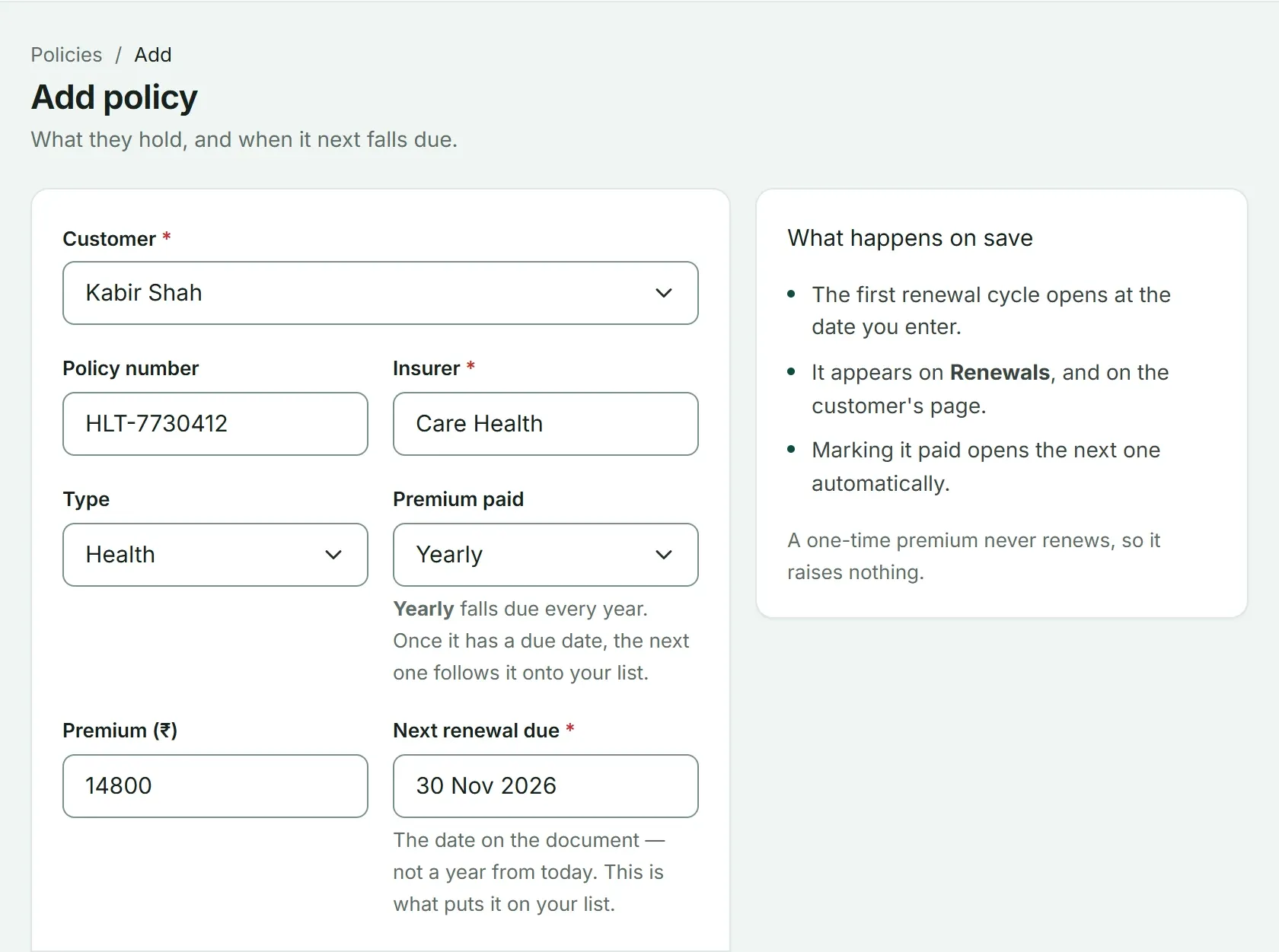
Adding a policy in Advisend. The panel on the right explains what happens on save: the renewal appears on the Renewals page and on the customer’s page, and marking it paid opens the next one automatically.
If you want to start with a spreadsheet, the renewal tracker template has all the columns ready, with Days left and Status filled in for you.
Step 2: Remind on a fixed schedule
A single reminder a week before the due date leaves no room for a client who is travelling, short of cash or unsure whether to renew. A schedule spreads the contact so that none of those problems becomes a crisis.
The renewal timeline
Here is what each step is for:
- At 90 days, you put the date on the client’s mind without asking for anything. It is the lightest touch.
- At 60 days, you ask whether anything has changed: a new family member, a new vehicle, a move, a change in income. This is the calm moment to discuss changes to the cover.
- At 30 days, you share the premium and offer a payment link or help paying.
- At 7 days, you check the payment is in motion. If the client has not replied to the 30-day message, call now.
- On the due date, you confirm. If it is paid, update your record. If not, offer help right away.
These days are a rhythm, not a rule. A client who always pays on time may need only the 30-day and 7-day messages. A client who often pays late may need the full sequence plus a call. The step-by-step version, with a table for different client types, is in The 90-60-30-7 renewal reminder timeline.
How to write reminders clients answer
A reminder works when it is short, personal and asks for one thing. Compare these two.
Dear customer, your policy is due. Please pay immediately to avoid lapse.
Hello Sunita ji, this is Ravi. Your health policy with {Insurer} renews on 15 Oct, and the premium is {Amount}. Shall I send you the payment link today?
The second names the client, the policy and the date, offers help and asks one question. It is also easier to answer than to ignore.
Four habits make reminders land:
- Use the client’s name and yours.
- Put the policy, the date and the amount in the first two lines.
- Ask for one thing. A payment link, a day, or a call time.
- Skip pressure words like “urgent” and “final notice”.
You do not need to write each message from scratch. Use the 10 WhatsApp renewal reminder messages for phones and the 8 renewal reminder email templates for email. Send on the channel your client actually answers. Some read WhatsApp within minutes and never open email, and some are the reverse.
What reaches you, so that you reach them
The hardest part of a schedule is not the wording. It is knowing, every morning, which client is on which step. That is the job of your reminder system.
In Advisend you set the days once, for example 90, 30, 7 and 1, and the time of day. You are reminded by email and WhatsApp, and Advisend can also email your customers ahead of the due date, on days you choose.
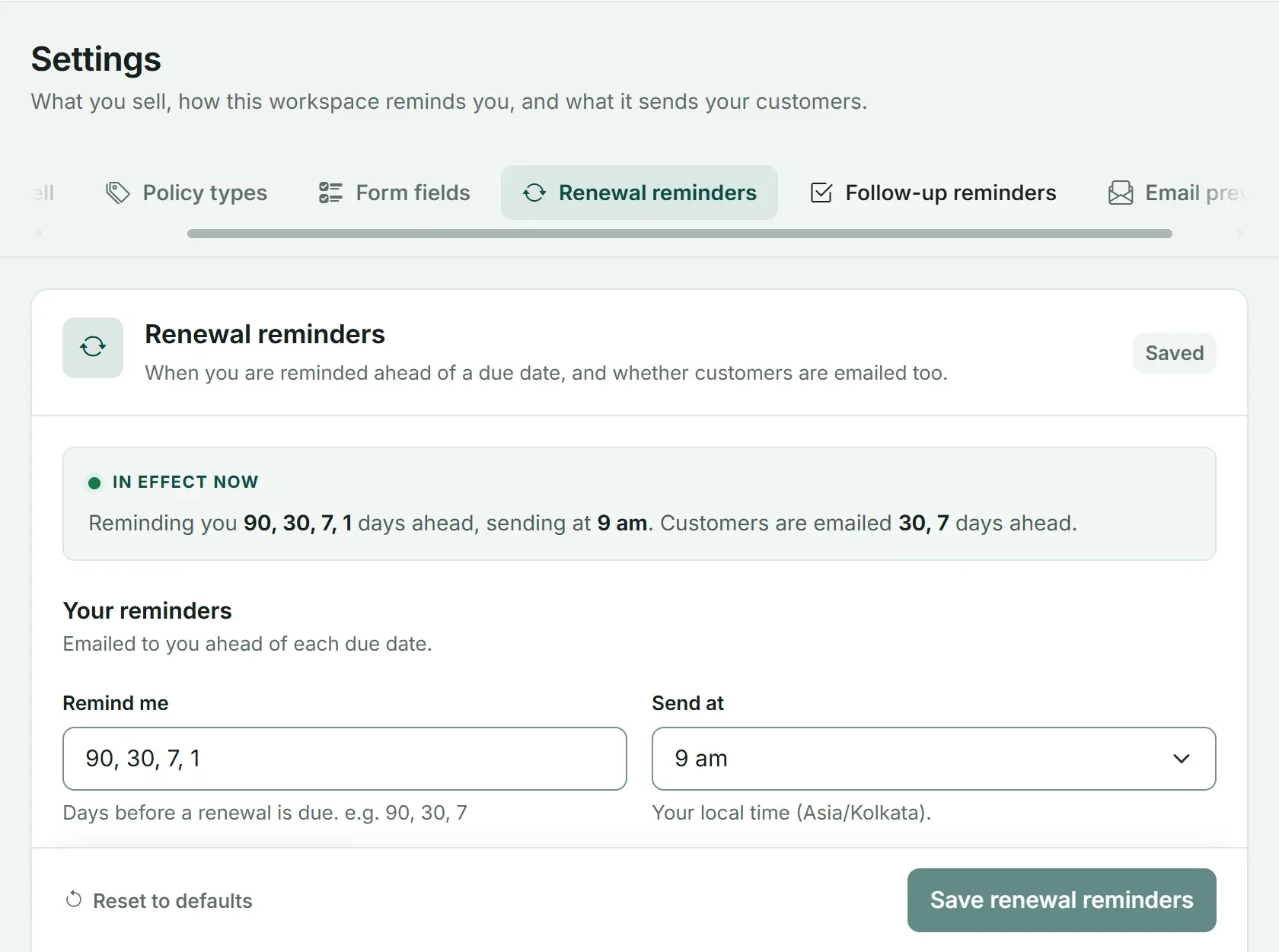
Reminder settings in Advisend. The panel at the top shows what is in effect right now: when you are reminded, at what time, and when customers are emailed.
Step 3: Retain the clients who delay
Even with a good schedule, some renewals will not go smoothly. These are the situations you will meet most, and how to handle each one without pressure.
The client who says “I will pay later”
This is the most common reply, and it is not a no. The risk is that “later” has no date. Turn it into one.
Of course, {Name}. Which day works best for you? I will check back with you then so it does not slip.
Then write that date in your list as the next step. A promised date you have recorded is far more reliable than a promise you are trying to remember.
The client who goes quiet
Silence usually means the message got buried, not that the client does not care. Change one thing each time you try again: the channel, the time of day or the length.
- Send a short WhatsApp message.
- Two days later, call.
- If there is still no answer, send an email that mentions you tried to call.
- Try once more on a different day and at a different time.
Record every attempt. When the client does reply, you can say exactly when you tried and show that you cared.
The client who finds the premium too high
Listen first. Then explain the options that exist for that product, such as changing the cover, the payment frequency or the plan, and let the client choose. Do not promise anything you have not checked with the insurer. Offering a review is a service. Pressuring a client to renew at any cost is not.
The client who wants to switch insurer
Ask why, and write down the answer. Sometimes it is price, sometimes it is a claim experience, sometimes a friend’s advice. If you can fix the real problem, do. If the client decides to move, the reason you recorded helps you serve the next client better, and a respectful goodbye leaves the door open.
When a policy has already lapsed
Do not wait. Contact the client the same day, find out what happened, and check your insurer’s terms on what is possible. Rules on grace periods, revival and the documents needed differ by insurer and product, so confirm before you make any promise. Record the outcome either way.
A note for mutual fund distributors
The same rhythm works for SIP instalments and mandates. The dates to watch are the instalment date and the mandate expiry. A stopped or failed instalment deserves a message the same day, just like a missed premium. Fund houses and banks differ in their rules, so check them rather than assume.
Step 4: Review every month
Without a review, the system quietly decays. Once a month, spend twenty minutes on four numbers:
| Number | How to get it |
|---|---|
| Renewals due this month | Count the policies whose due date fell in the month |
| Paid on time | How many were paid on or before the due date |
| Paid late | How many were paid after the due date |
| Lost | How many were not renewed |
Your renewal rate is the number paid, on time or late, divided by the number due. Watch the trend, not just the number. If “paid late” is growing, your reminders are starting too late. If “lost” is growing, look at the reasons you recorded.
Then ask two questions. Which step of the timeline did the late ones skip? Which clients should move to a longer sequence next month? Small adjustments each month are worth more than one big redesign.
Excel or a reminder app?
Both can run the system. The difference is who does the reminding.
| Task | Excel sheet | Advisend |
|---|---|---|
| See what is due this month | Sort or filter by date | Renewals page with Overdue, Next 30 days and Next 90 days |
| Get reminded | You must open the sheet | Reminders by email and WhatsApp before each due date |
| Choose reminder days | Whatever you build yourself | Set your own days and the time they are sent |
| Mark a renewal as paid | Edit the row, type next year’s date | Mark paid, and the next due date is set for you |
| Find a policy fast | Ctrl+F or a filter | Search by customer, policy number or insurer |
Excel is a good place to start, and for a small book it can be enough. The honest side-by-side, including where Excel wins, is in Excel or a renewal reminder app?. A simple rule: if you have missed a renewal in the last year, or the sheet takes more time than your clients do, it is time to try an app.
How Advisend handles renewals
Advisend is built around exactly this system. This is what it does today.
- One renewals page. Overdue, Next 30 days, Next 90 days and All open, with the customer, policy, due date and premium on each row.
- Reminders on your schedule. You choose the days and the time. They reach you by email and WhatsApp.
- Customer emails. Advisend can email your customers ahead of the due date, on days you choose.
- Mark paid, and the next one opens. No retyping dates each year.
- Search. Find a policy by customer, policy number or insurer.
- A record per client. Policies, contact details and every follow-up sit on the customer’s page.
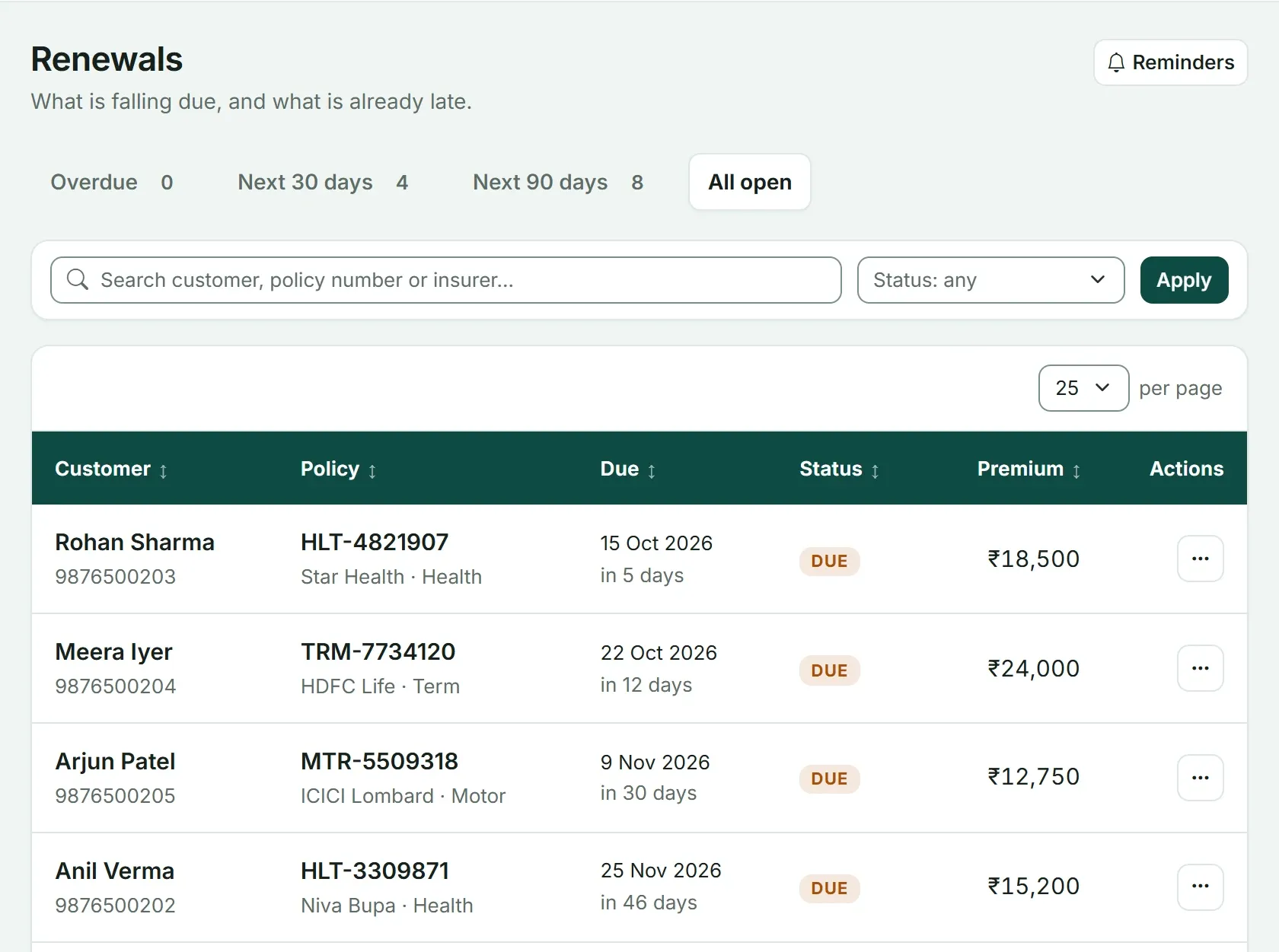
The Renewals page. Each row shows who, which policy, when it is due and how many days are left. The row menu has Mark paid.
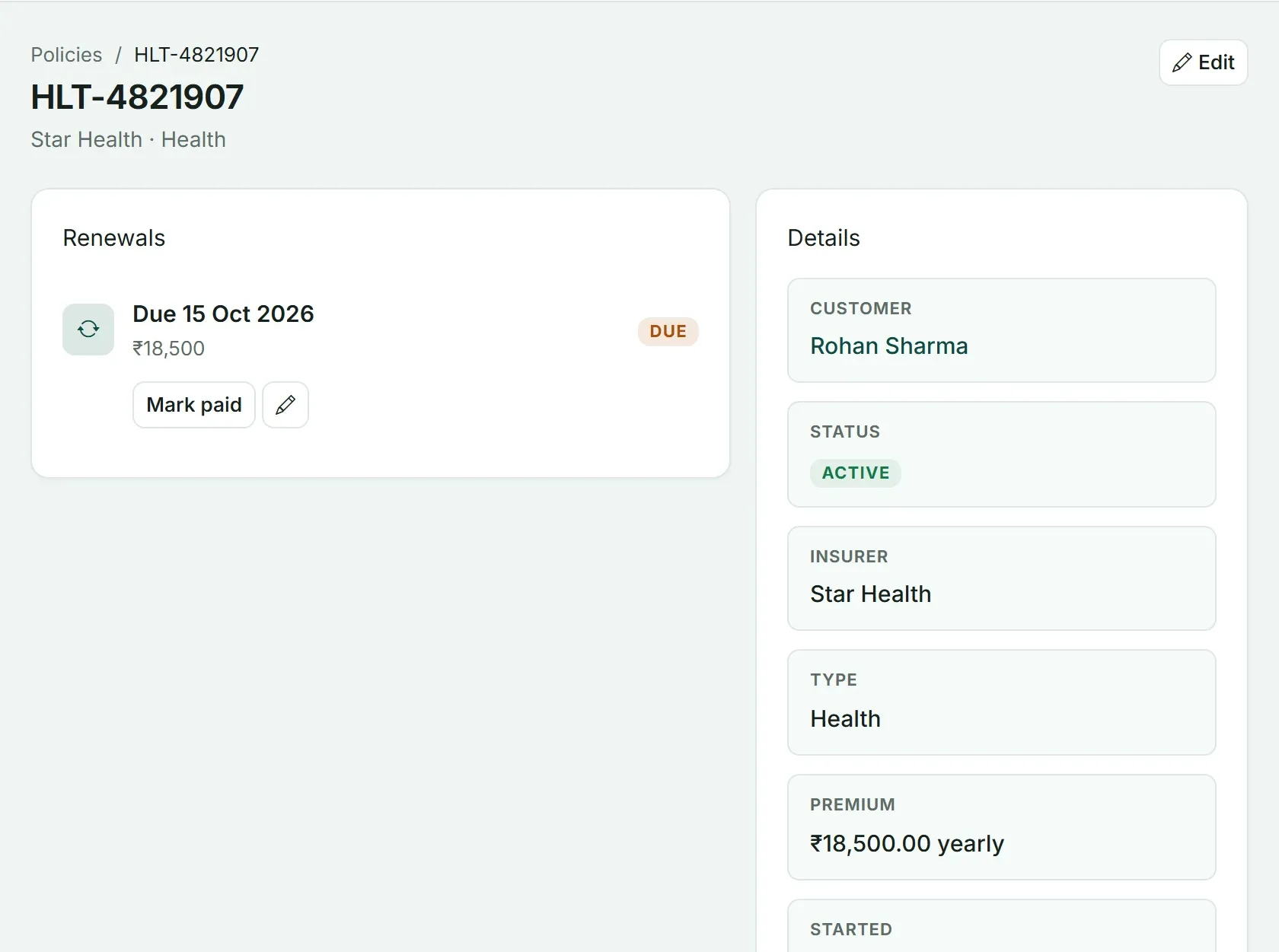
A policy page. The renewal is shown as due, with the amount and a Mark paid button. Marking it paid opens the next renewal.
You still write to your clients in your own voice. Advisend makes sure you never forget to. We are also working on letting you send messages from your own WhatsApp number, and a mobile app is planned.
See how Advisend handles renewals, or start free and add the policies due in the next 90 days. No card needed. Start free in minutes.
Six mistakes that cause missed renewals
Most lost renewals trace back to the same few habits. Check your own routine against this list.
- Starting too late. A first message at 7 days leaves no room to fix a problem. Start at 30 days at the latest, and at 90 for clients who may change cover.
- Keeping dates in more than one place. When half your renewals live in a diary and half in a sheet, neither is complete. Pick one list and move everything into it.
- Using an approximate date. “About a year from the last one” is not a due date. Take it from the policy document.
- Reminding without a next step. A message that ends “let me know” gives the client nothing to do. End with one question or one offer.
- Not writing down the promise. “I will pay on Friday” is only useful if Friday is in your list with a follow-up attached.
- Never looking back. Without a monthly review, you repeat the same misses. The four numbers take twenty minutes and show you where the system leaks.
None of these needs special software to fix. They need one list, one schedule and one habit, which is exactly what the four steps above give you.
A 30-day plan to put the system in place
You do not need to build everything at once. This plan takes about an hour a week.
Week 1: Get every policy in one place
Gather your renewals from the diary, the calendar and the chats. Enter the policies due in the next 90 days first, because they matter most. Then add the rest over a few days. Use the seven fields above.
Week 2: Set your schedule and your words
Decide your reminder days. Copy the templates you like, from the WhatsApp messages and the email templates, and save them where you can reach them fast.
Week 3: Run the morning routine
Every morning, ten minutes: look at Overdue, contact anyone due within 7 days, mark paid renewals, and write down the next step for each one. This is the habit that makes everything else work.
Week 4: Review and adjust
Count renewals due, paid on time, paid late and lost. Note which step of the timeline the late ones missed. Change one thing for next month, and only one.
After 30 days you have a list you trust, a rhythm you can keep and the first set of numbers to improve.
Where to go next
If you read nothing else, take these three steps this week:
- Put every policy due in the next 90 days into one list.
- Pick your reminder days and write down the first message.
- Block ten minutes every morning for the list.
Everything else in this guide builds on those three.
The supporting posts, in the order most agents need them:
- How to track insurance renewals without missing a single one
- 7 things to record on every policy
- The 90-60-30-7 renewal reminder timeline
- 10 WhatsApp renewal reminder messages
- 8 renewal reminder email templates
- Insurance renewal tracker in Excel
- Excel or a renewal reminder app?
- SIP follow-up checklist for distributors
Questions agents ask
What is insurance renewal management?
It is the routine an agent or broker uses to make sure every client's policy is renewed on time. It has four parts: record every policy, remind clients on a fixed schedule, follow up with those who delay, and review the results each month.
How early should I start contacting a client about a renewal?
A practical pattern is 90 days before the due date for a heads-up, 60 days to check for changes, 30 days to share the amount, and 7 days to close the loop. Adjust the days to suit each client.
What is the best way to remind clients of a renewal?
A short message on WhatsApp or by email, with the policy, the date and the amount, followed by a call if there is no reply. Use the channel the client actually answers.
Is Excel enough to manage renewals?
For a small book, yes, if you open it every day. Its weak point is that it never reminds you. Agents usually move to an app after a missed renewal or when the sheet takes more time than the clients.
What should I track for every policy?
The policy number, insurer, type, premium and how often it is paid, the renewal due date, the best way to reach the client, and your last contact with the next step.
What should I do when a policy has already lapsed?
Contact the client at once, find out why, and check your insurer's terms on what can be done. Rules differ by insurer and product, so do not promise anything before you have checked.
Can Advisend manage renewals for me?
Advisend keeps every policy and due date in one list, shows what is overdue and what is coming, and reminds you by email and WhatsApp on the days you choose. You still write to your clients in your own voice.
One list of what is due and what is late, with reminders sent on the days you choose.
Advisend keeps your renewals in one place and reminds you by email and WhatsApp, so you can spend your day with clients.
Keep reading
The 90-60-30-7 Renewal Reminder Timeline (With Exact Actions)
What to do 90, 60, 30 and 7 days before a renewal, and on the due date: the exact message, the exact action, and why each step is there.
Updated 27 Oct 2026GuideHow to Track Insurance Renewals Without Missing a Single One
The four ways agents track renewals, where each one breaks, and a simple daily and weekly routine that keeps every due date in front of you.
Updated 27 Oct 2026TemplateInsurance Renewal Tracker in Excel and Google Sheets: Download the Template
A ready-made Excel renewal tracker that counts the days left, colours every policy by urgency and shows who to call today. Works in Excel and Google Sheets.
Updated 27 Oct 2026