
Lead follow-up is the routine that makes sure every prospect hears from you again until they become a client or say no. It has four parts: capture every lead in a minute, give each one a next date, follow up in a way that is useful and not pushy, and move the lead to your client list when they buy. An agent who does these four things rarely loses a lead by forgetting.
This guide walks through the whole system, from the first call to the first policy. Each section links to a shorter post with a template you can use today. Read it from top to bottom, or jump to the part that is hurting you most.
If you want the system running while you read, Advisend keeps every lead and every promise in one list. Start free. No card needed. Start free in minutes.
Why leads go quiet
Leads rarely say no. They go quiet.
A prospect says “call me next week.” The week gets busy. You mean to call, but nothing reminds you, and the lead was never written down with a date. By the time you remember, the moment has passed and the conversation feels awkward to restart.
That is not a failure of effort. It is a failure of system. A lead goes quiet for the same reason a renewal is missed: the date lived in your memory, and memory is the weakest place to keep it.
The cost shows up in three places:
- The lead. Someone who wanted help with cover is left to decide alone, or to buy from whoever called back first.
- Your time. Every lead you worked to find is work thrown away if the next step never happens.
- Your confidence. Not knowing who you forgot makes every quiet day feel like a missed chance.
You do not need a statistic to see it. Any agent who has remembered a lead three weeks late knows the feeling. The system below is built so that it does not depend on a good week.
Where agents keep leads today, and where each one breaks
Almost every agent starts with one of these.
| Method | What works | Where it breaks |
|---|---|---|
| Phone contacts and call log | Always with you, easy to dial | No date, no notes, no list of who is waiting |
| WhatsApp chats | Where leads actually reply | Old chats sink. Nothing tells you who is overdue |
| Paper diary | Quick to write | Hard to search. Nothing alerts you |
| Spreadsheet | Sortable, searchable, shareable | It does not remind you. Notes get thin |
| Follow-up app | Sends the reminder to you, keeps the history | Needs a short setup, and you enter each lead once |
Every method fails the same way: on the day you are busy, nothing pulls the lead in front of you. A good system has to reach you, not wait for you to open it. For a ready-made sheet, see the lead tracker template.
The system: capture, date, follow up, convert
Four steps, in order. Each is small. The power is in doing all four every time.
- Capture. Write the lead down the moment you speak, with just enough detail.
- Date. Give every lead a next follow-up date before you hang up.
- Follow up. Contact the lead on that date, say something useful and set the next date.
- Convert. When the lead buys, move them to your client list and start looking after them.
Then, once a month, review what the numbers tell you.
Step 1: Capture the lead in one minute
A lead you did not write down does not exist. The best moment to capture is straight after the conversation, while you remember it.
Keep the first entry short. Four details are enough:
- Name.
- Mobile number. It is how you find the lead again. A household may share a number, and that is fine.
- What they are interested in. Health, term, motor, an investment and so on. It tells you what to say next.
- How they found you. A referral, a walk-in, a WhatsApp message, an event. This is the most skipped field and one of the most useful.
Add a priority as well: Hot if they are ready to talk now, Warm if they are interested but not in a hurry, Cold if they may need time. Hot leads should sit at the top of every list you look at.
Everything else can wait. If the form is long, you will skip it, and an incomplete lead is better than a lead you never recorded.
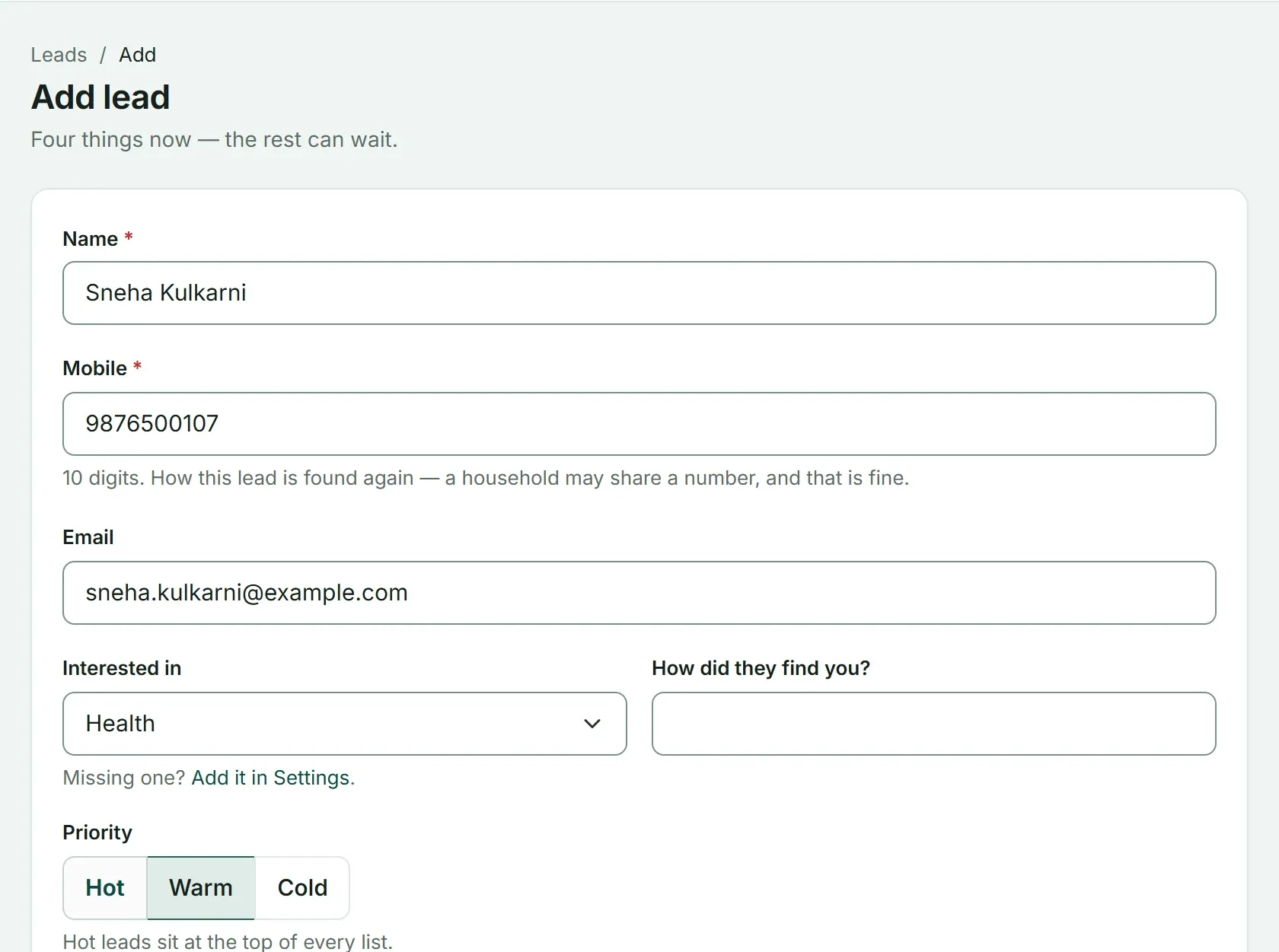
Advisend’s Add lead form asks for four things now: name, mobile, interest and source, plus a Hot, Warm or Cold priority. The rest can wait.
If you work in a sheet, the lead tracker template has all these columns ready, with a Follow-up column that colours overdue leads.
Step 2: Give every lead a next date
This is the rule that holds the whole system up: no lead without a next date.
A lead with a name and no date is a lead you will forget. A lead with a date appears on the right morning, and the date is what turns good intentions into a call.
Set the date before you end the conversation. If the lead says “call me next week,” ask which day, and write it down. “Tuesday morning” beats “sometime next week.” A specific day also gives you something kind to say: “I will call you on Tuesday, is morning fine?”
If you are not sure how far apart to space your follow-ups, start with a rhythm. The Day 1, 3, 7, 14 follow-up schedule is one: thank them on day 1, send something useful on day 3, ask for a next step on day 7 and close the loop on day 14. It is a starting point, not a rule. Adjust it to the lead.
| Lead | Suggested rhythm |
|---|---|
| Hot lead who asked for a quote | Same day or next day, then day 3 |
| Warm lead comparing options | Day 1, 3, 7 and 14 |
| Cold lead from an event or a list | Start at day 3 and keep it light |
| Referral from a client | Thank the person who referred them as well |
Step 3: Follow up without being pushy
On the day, you need three things: a good reason to contact the lead, a short message or call, and a next date at the end.
Start the day from one list
Every morning, open the list and look at what is overdue first, then what is due today. Work from the top: Hot leads, then Warm. This takes about ten minutes to plan and saves hours of wondering.
Advisend shows this as a Today list of everyone who needs you, with Hot leads marked, and can email you a daily worklist at the hour you pick.
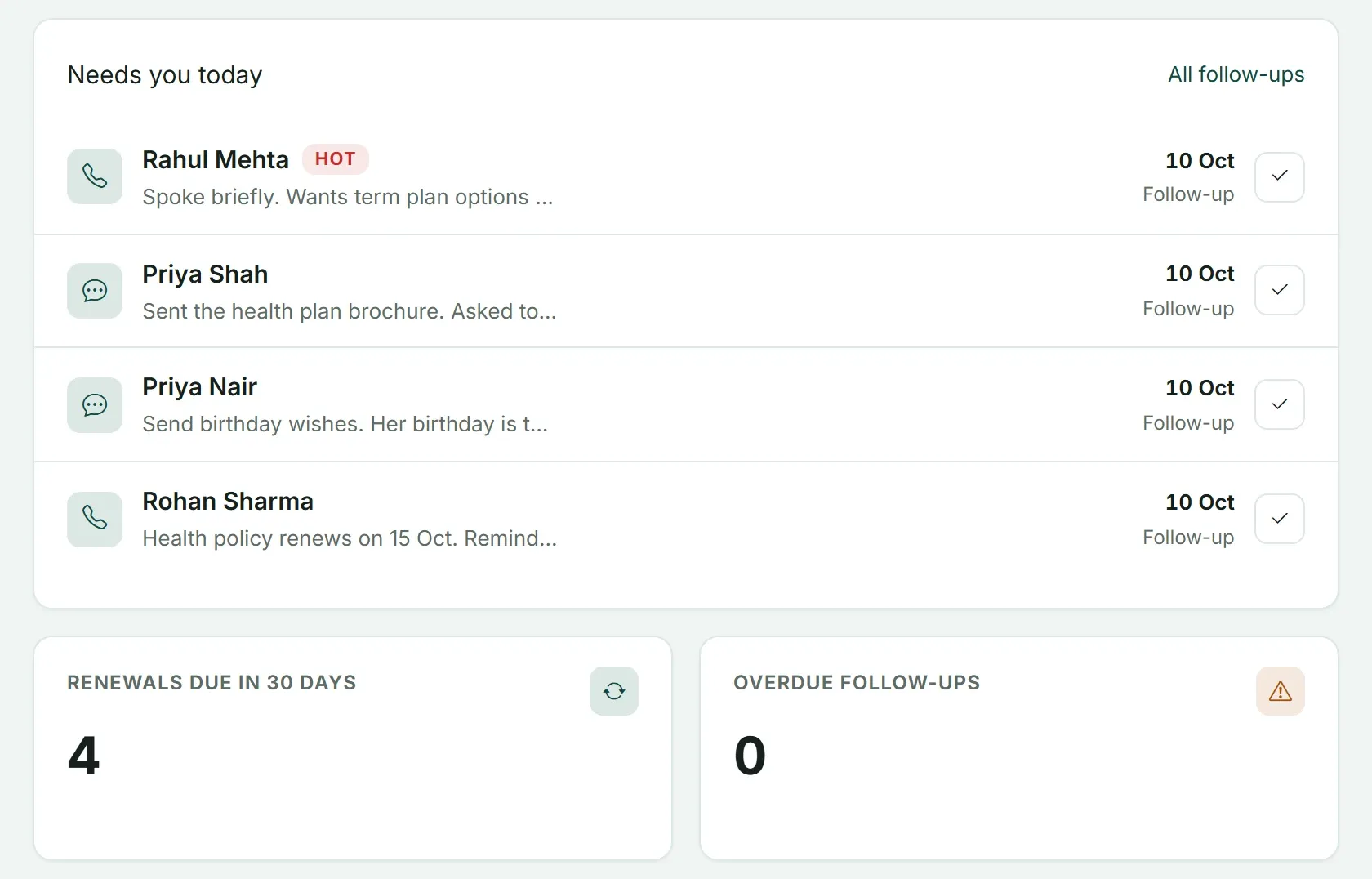
Advisend’s Today list: who needs a call or a message today, with Hot leads marked. Ticking one off lets you schedule the next follow-up.
The first follow-up call
A good first follow-up has four parts. None needs a script.
- Open with the reason. “You asked about a family health plan last week, so I am calling with two options.”
- Ask one question. What matters most to them? Cover, cost, a particular hospital?
- Offer one next step. Send details on WhatsApp, or meet on a day that suits them.
- Set the date. End by agreeing when you will speak again.
Choose the channel the lead answers
A call is better for a first conversation and for asking for a decision. WhatsApp is better for sending something useful and for a gentle nudge. Email suits longer explanations. Use the one the lead replies to, and write down which it is.
Write down what was said
After every contact, record three things: what happened, what was promised, and the next date. “Called, wants term cover for 1 crore, will decide after Diwali, call on 3 Nov” is a complete note. It stops you from asking the same question twice, and it lets anyone covering for you carry on without guessing.
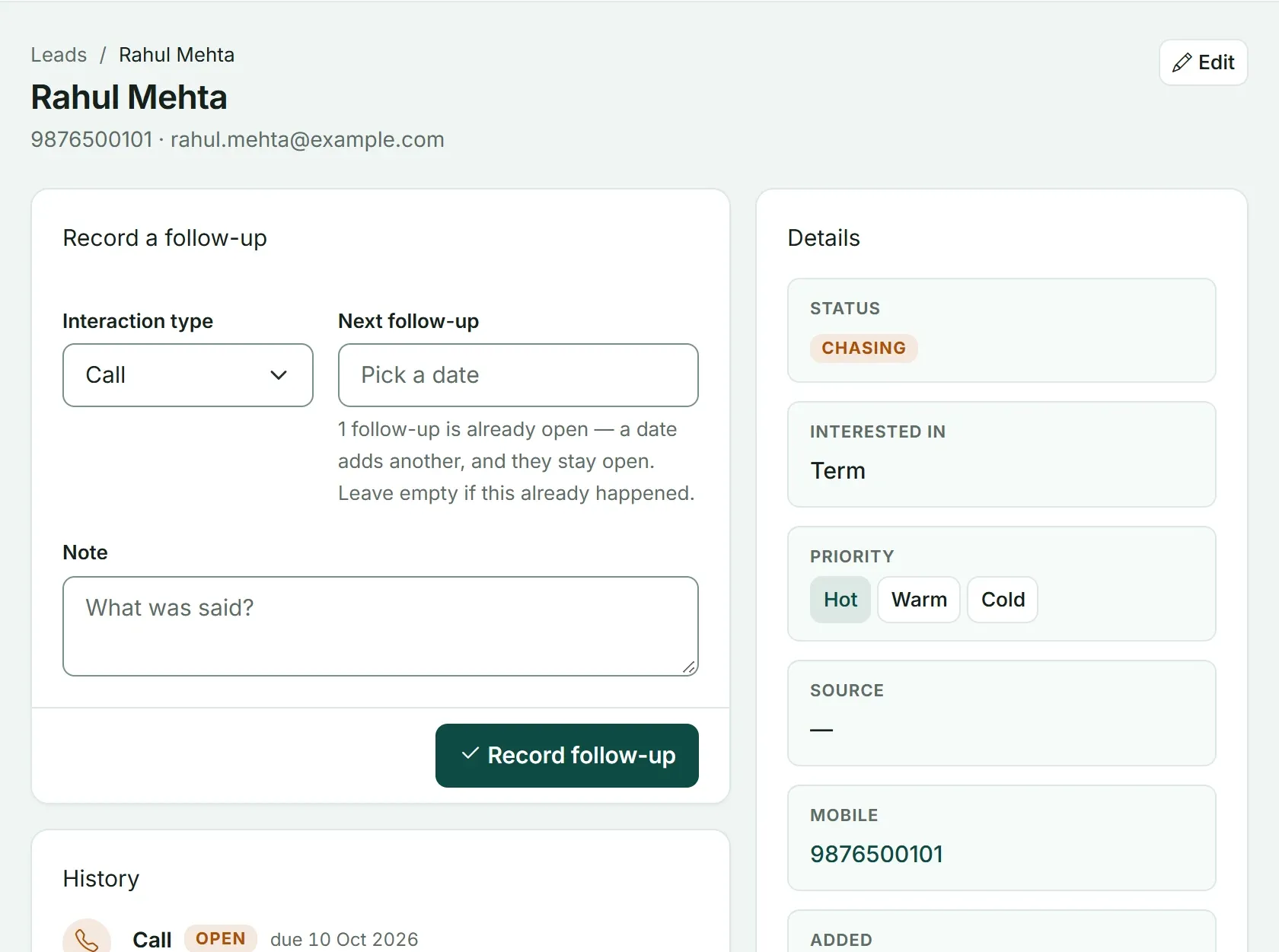
A lead page in Advisend: record what was said, pick the next follow-up date, and see the status, interest and priority on the right.
When a lead goes silent
Silence does not always mean no. A calm sequence works better than a burst of messages.
- Send one short, helpful message that is easy to answer. A question beats a reminder.
- Call once. A voice often gets a reply where text does not.
- Set a slow check-in date, such as a month away, and write down where the lead stood.
- Close politely if they say no. Thank them and keep the door open.
Do not send five messages in two days. Do not make the lead feel chased. If a lead says they want to stop, respect that and note it.
Know when to stop
Following up has an end. When a lead says no, when a full sequence has passed in silence, or when the need is gone, mark the lead as lost and record why. Do not delete it. Circumstances change, and a lead who said no in January may need help in October.
Step 4: Convert the lead and look after the client
A lead becomes a client the moment they buy. That is a different relationship, and it deserves a different list.
The move goes one way. A lead who buys is moved to your client list, with the history of your follow-ups going with them. A client who later needs something new, such as a car cover years after a health plan, is not a new lead. It is a follow-up on the client you already know.
In Advisend, you convert a lead to a customer in one tap, and the follow-up history carries across. In a sheet, set the stage to Won and add the person to your client database.
After conversion, three things matter:
- Record the policy so the renewal date is on your list from day one. The routine for that is in Insurance renewal management for agents.
- Say thank you. A short message after the first payment does more than most agents expect.
- Start the relationship. Birthdays, check-ins and an annual review keep a client with you. That is covered in Client relationship management for agents.
Review every month
Once a month, spend 30 minutes with your numbers. You do not need a dashboard. A list and a pen are enough.
| Question | Why it matters |
|---|---|
| How many leads did I add? | Shows whether your sources are working |
| How many did I contact within two days? | Shows how fast you respond |
| How many meetings did I book? | Shows how well you ask for the next step |
| How many became clients? | The number that counts |
| Which source gave the best leads? | Tells you where to spend your time |
| Which Hot leads have been waiting too long? | These are the ones to call first |
The numbers will be your own. A few small questions asked every month show you what to fix.
Excel or a follow-up app?
A sheet is a good place to begin, and for a small book it can be enough. It gives you search, sorting and colour, and you own the file. Its weak points are the ones that hurt on a busy day: it never reminds you, a notes column cannot hold a month of calls, and it is slow to edit on a phone.
An app earns its place when you want the reminder to come to you and the history to stay with the lead. A simple rule: if you have lost a lead because you forgot, or the sheet takes more time than the leads do, try an app. The honest side-by-side, written for renewals but true for leads too, is in Excel or a renewal reminder app?.
How Advisend handles lead follow-up
Advisend is built around exactly this system. This is what it does today.
- Quick capture. Add a lead with a name and a number, then fill in interest, source and priority when you can.
- A next date for every lead. You record each follow-up with a note and a date, and open ones stay on the list.
- A Today list. Everyone who needs a call or a message today, with Hot leads marked.
- A daily email. One worklist in your inbox, with what is overdue and what is due, on the days and at the hour you pick.
- List and board views. Search and filter leads by status, interest and priority.
- One-tap conversion. Convert a lead to a customer, with the follow-up history carried across.
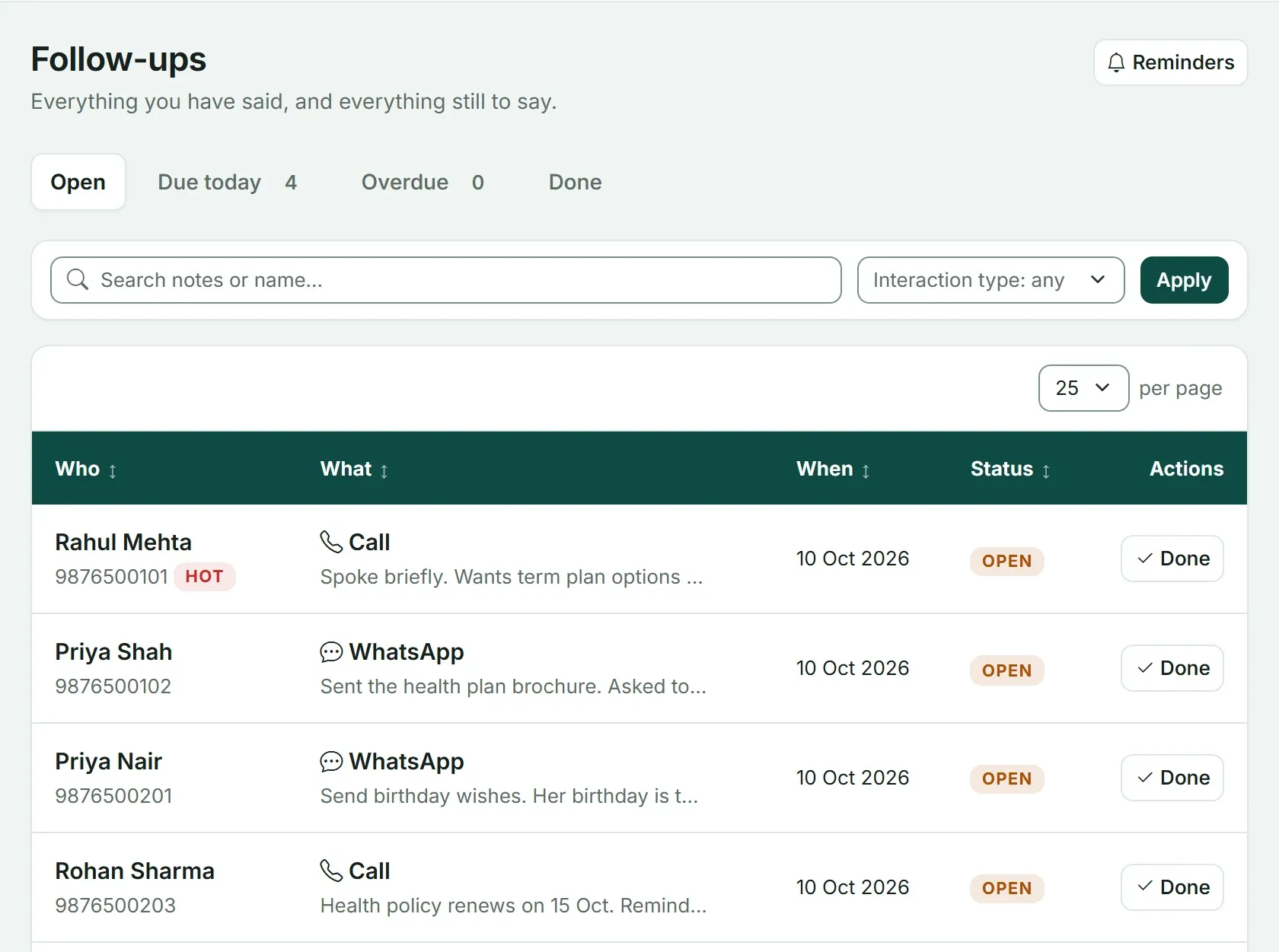
The Follow-ups page: tabs for Open, Due today, Overdue and Done, with the note and next step on each row.
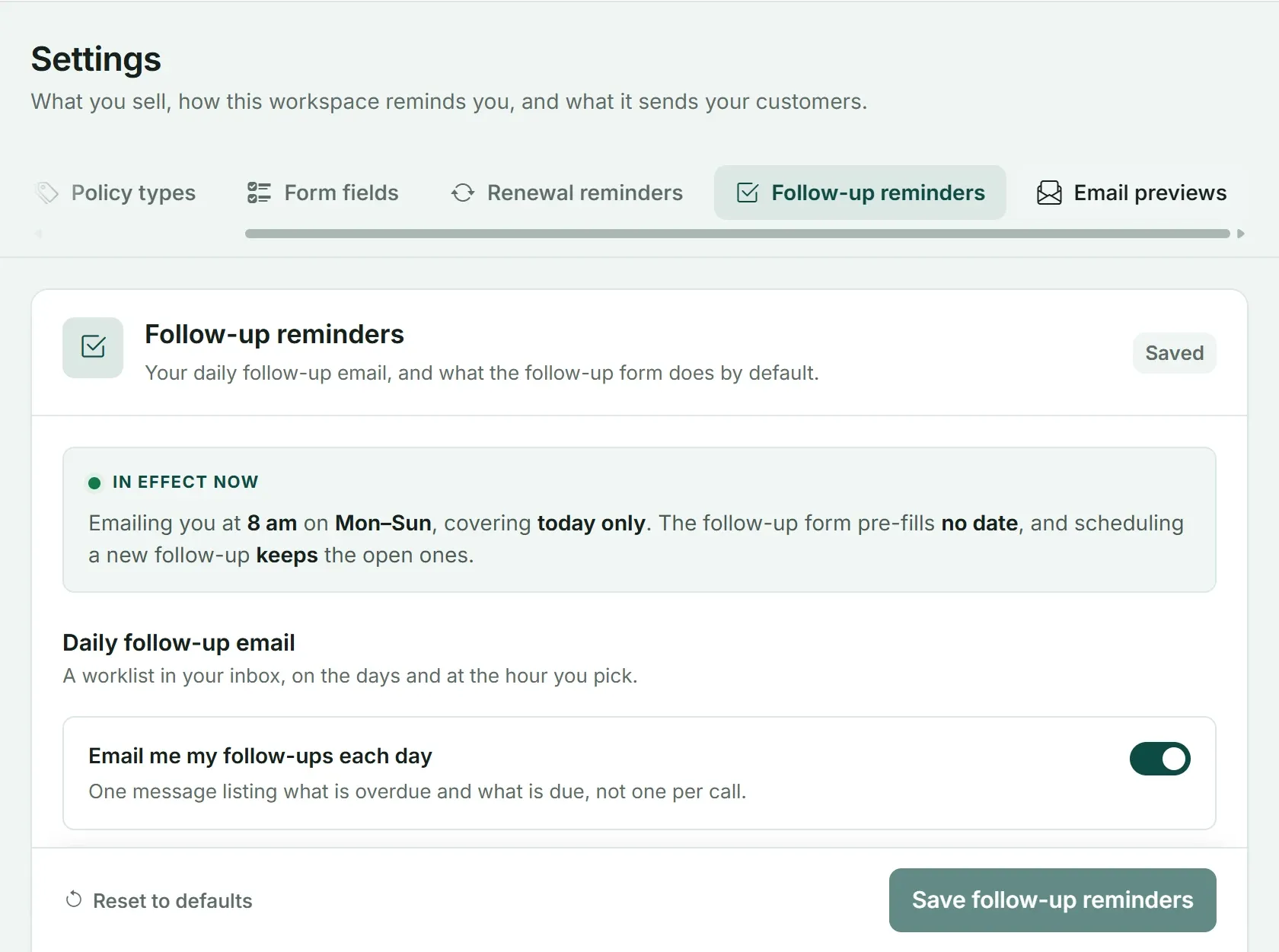
Follow-up reminder settings: choose whether to get a daily email, and when.
You still talk to your leads in your own voice. Advisend makes sure you never forget to. We are also working on letting you send messages from your own WhatsApp number.
See how Advisend handles follow-ups, or start free and add the leads you are chasing this week. No card needed. Start free in minutes.
Six mistakes that cost leads
- Not writing the lead down. If it is not recorded, it will be forgotten.
- Leaving a lead with no next date. The date is what brings the lead back to you.
- Following up with a reminder and nothing useful. “Just checking in” gives the lead nothing to answer.
- Chasing too hard. A burst of messages feels like pressure. Space them out.
- Never closing a lead. An old list full of dead leads hides the live ones. Mark lost leads and record why.
- Treating a client as a new lead. A client with a new need is a follow-up on the client.
A 30-day plan to put the system in place
Week 1: capture. Gather every lead you can remember from your phone, chats and diary into one list. Add a source and a priority to each. Do not worry about perfect data.
Week 2: date. Give every lead a next follow-up date. Start your 10-minute morning routine: overdue first, then due today.
Week 3: follow up well. Pick a rhythm, such as day 1, 3, 7 and 14. Write down what was said after every contact. Close any lead that has said no.
Week 4: review. Count leads added, contacted, met and won. Note which source worked best and which Hot leads waited too long. Adjust.
After 30 days you have a list you trust, a rhythm you can keep and the first numbers to improve.
Where to go next
If you read nothing else, take these three steps this week:
- Put every lead you are chasing into one list.
- Give each one a next follow-up date.
- Block ten minutes every morning for the list.
Everything else in this guide builds on those three.
The supporting posts, in the order most agents need them:
Questions agents ask
How many times should I follow up with an insurance lead?
There is no magic number. Keep following up for as long as the lead shows interest and a next step is agreed, and stop when they say no or stay silent through a full sequence. A simple starting rhythm is day 1, 3, 7 and 14, then a slow check-in.
What is the best way to track insurance leads?
One list that holds every lead, shows a next follow-up date for each, and puts the overdue ones at the top. A spreadsheet works for a small book if you open it every day. An app is better when you want the reminder to come to you.
What should I do when a lead goes silent?
Send one short, helpful message that makes it easy to reply, call once, and then set a slow check-in date. Do not send a string of reminders. Record what happened so a later call picks up where you stopped.
When does a lead become a client?
When they buy a policy or invest with you. From that point, move them from your lead list to your client list, and treat any new need as a follow-up on the client, not as a new lead.
Should I follow up by call or WhatsApp?
Use the channel the lead answers. A call is better for a first conversation and for asking for a decision. WhatsApp is better for sharing something useful and for a gentle nudge. Many agents use both.
Can Advisend manage leads for me?
Advisend keeps every lead, its priority and every follow-up in one list, shows who needs you today and emails you a daily worklist at the hour you pick. You still talk to your leads in your own voice.
Every lead and promise in one worklist, so nobody goes cold.
Advisend keeps your follow-ups in one place and reminds you by email and WhatsApp, so you can spend your day with clients.
Keep reading
Lead Tracker in Excel: Download the Template
A ready-made Excel lead tracker for insurance agents. It shows who to follow up today, colours every lead by urgency and records the source of each lead. Works in Excel and Google Sheets.
Updated 27 Oct 2026TemplateThe Day 1, 3, 7, 14 Follow-Up Schedule (Template)
A simple follow-up rhythm for new insurance leads: what to send on day 1, 3, 7 and 14, with a downloadable Excel schedule that works out the dates for you.
Updated 27 Oct 2026Complete guideClient Relationship Management for Agents: The Complete Guide
A complete guide for insurance agents and distributors to keep clients for years: record what matters, stay in touch the right way, remember important dates, and ask for referrals gently.
Updated 27 Oct 2026