
A good renewal reminder is short, uses the client’s name, and asks for one thing. The 10 messages below cover every stage of a renewal. Copy one, replace the words in {curly brackets}, and send.
They work for insurance agents, brokers and mutual fund distributors alike. Change “policy” to “SIP” or “investment” where it fits.
Advisend reminds you by email and WhatsApp when each message is due, so you never forget to send one. Start free. No card needed. Start free in minutes.
Before you send: 5 quick rules
- Use the client’s name and yours. “Hello Sunita ji, this is Ravi” gets read. “Dear customer” does not.
- Ask for one thing. Confirm a date, share a payment link, or pick a time to talk. Never all three.
- Keep it under five lines. People read WhatsApp on the move.
- Send at a sensible hour. Between 9 am and 8 pm.
- Write down what you sent. A note in your tracker saves you from asking twice. What to note is covered in 7 things to record on every policy.
Messages for each stage of the renewal
1. The early heads-up (90 days before)
Hello {Name}, this is {Your name}. Your {policy type} policy with {Insurer} is due for renewal on {Due date}.
There is nothing to do today. I will remind you again closer to the date. If you would like to review your cover before then, just tell me and we can set a time.
2. The planning nudge (60 days before)
Hello {Name}, a quick note from {Your name}. Your {policy type} policy renews on {Due date}, about two months from now.
Is there any change in your family, health or income I should know about before we renew?
3. The amount message (30 days before)
Hello {Name}, your {policy type} policy ({Policy number}) renews on {Due date}. The premium is {Amount}.
Would you like me to share the payment link, or will you pay directly? Either is fine.
4. The one-week nudge (7 days before)
Hello {Name}, your {policy type} renewal is due in 7 days, on {Due date}. Premium: {Amount}.
Shall I send you the payment link today?
5. The due-date message
Hello {Name}, today is the due date for your {policy type} renewal ({Amount}).
If you have already paid, please send me a screenshot and I will update my records. If not, I can help you pay right now.
6. After the due date, no reply
Hello {Name}, I see your {policy type} renewal that was due on {Due date} is still pending on my side.
If you have paid, please let me know. If not, I would like to help you sort it out today so your cover is not affected.
Grace periods and lapse rules differ by insurer and product. Check your insurer’s terms before you tell a client what happens next.
7. When the client says “I will pay later”
Of course, {Name}. Which day works best for you? I will check back with you then so it does not slip.
8. After the client renews
Thank you, {Name}. Your {policy type} policy is renewed. The next due date is {Next due date}.
I have noted it, and I will remind you well before then.
9. A SIP instalment that did not go through
Hello {Name}, your SIP instalment of {Amount} for {Fund name}, due on {Date}, could not be processed.
Common reasons are a low balance or an expired mandate. Could you check with your bank, or shall we set up the mandate again together?
10. When you tried calling and could not reach them
Hello {Name}, I tried calling you about your {policy type} renewal due on {Due date}.
When is a good time for a five minute call? Or reply here and I will help you over chat.
Tone: firm, never pushy
The goal is a client who renews and still likes hearing from you. Offer help in every message, and avoid words like “urgent” or “last warning”. If a client has told you they want to stop, respect that and note it.
Never send the wrong message on the wrong day
The hard part is not the wording. It is knowing, every morning, which clients need which message. The 90-60-30-7 timeline says which message goes out on which day. That is why agents build a tracker. If you use a sheet, the renewal tracker template colours each row by how soon it is due.
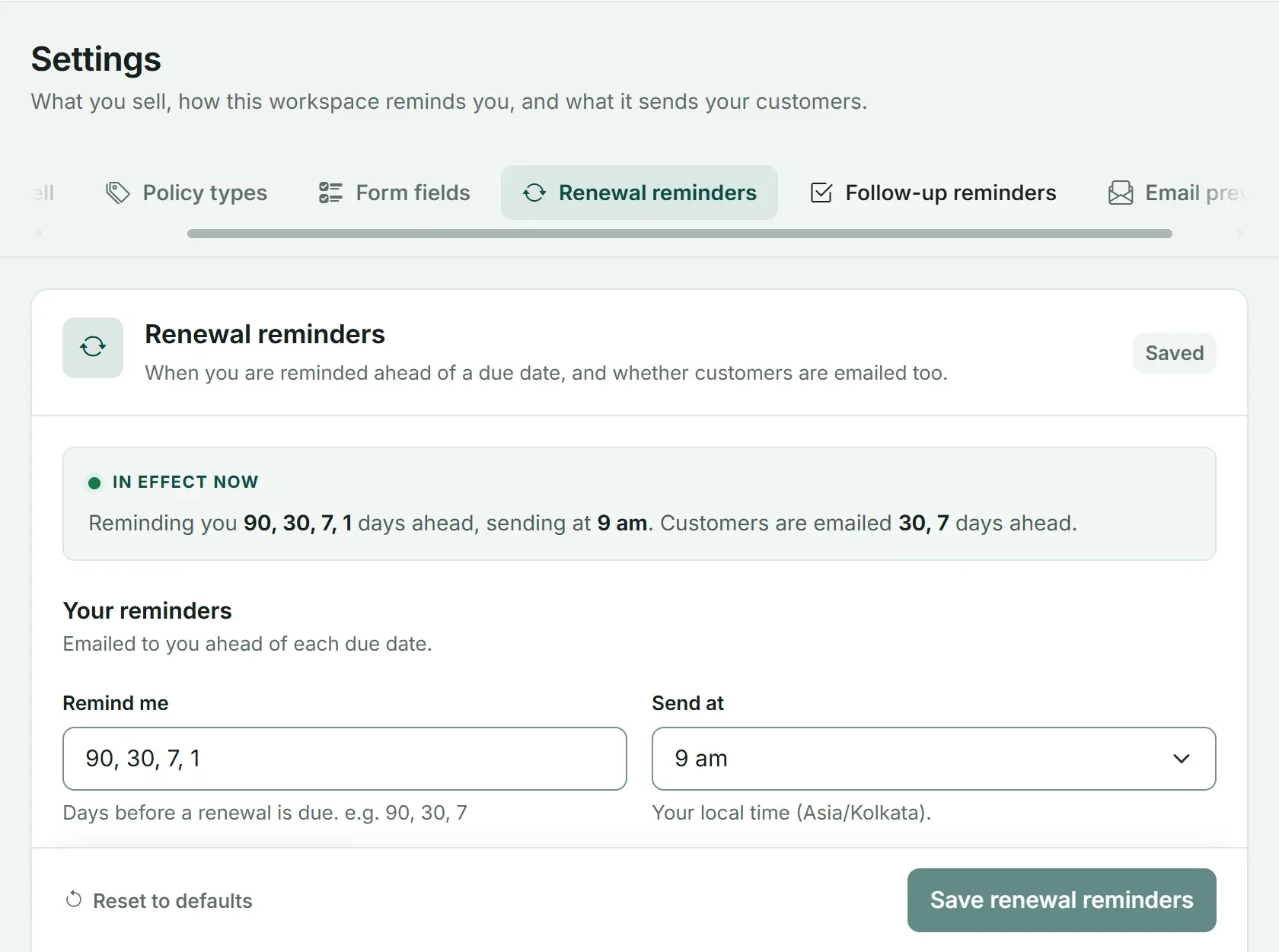
In Advisend you choose the days (here 90, 30, 7 and 1) and the time of day. It reminds you by email and WhatsApp, and can email your customers too.
You still write the message in your own voice. Advisend makes sure you never forget to send it.
See how Advisend handles renewals, or start free. No card needed. Start free in minutes. Prefer email? Use the renewal reminder email templates. The wider system is in Insurance renewal management for agents.
Questions agents ask
What is the best time to send a renewal reminder on WhatsApp?
A practical pattern is a first heads-up 60 to 90 days ahead, a message with the premium amount at 30 days, a short nudge at 7 days, and a final one on the due date. Send between 9 am and 8 pm so it reads as service, not pressure.
Should I remind clients by WhatsApp or by phone call?
Send a short message first. It is easy to answer and leaves a record. If the client has not replied in two or three days, call, and mention the message you sent.
Can Advisend send these reminders for me?
Advisend reminds you by email and WhatsApp before each renewal is due, so you always know who to message and when. It can also email your customers ahead of the due date. We are working on letting you send messages like these from your own WhatsApp number.
One list of what is due and what is late, with reminders sent on the days you choose.
Advisend keeps your renewals in one place and reminds you by email and WhatsApp, so you can spend your day with clients.
Keep reading
The 90-60-30-7 Renewal Reminder Timeline (With Exact Actions)
What to do 90, 60, 30 and 7 days before a renewal, and on the due date: the exact message, the exact action, and why each step is there.
Updated 27 Oct 2026TemplateInsurance Renewal Tracker in Excel and Google Sheets: Download the Template
A ready-made Excel renewal tracker that counts the days left, colours every policy by urgency and shows who to call today. Works in Excel and Google Sheets.
Updated 27 Oct 2026ComparisonExcel or a Renewal Reminder App? A Side-by-Side for Agents
An honest comparison of tracking renewals in Excel and in a reminder app: what each does well, where each falls short, and how to decide which fits your book.
Updated 27 Oct 2026